A General Theory of Love
Concept: Michael O’Connor
Performance: Mike O’Connor and partner
Vocal Performance: Inertia DeWitt
Choreography: Mike O’Connor and Brandon Gonzalez
Music/Sound: Al Green, Percy Sledge, Brandon Gonzalez
Production: Joachim Kapuy
Supported by: Department of Cultural Affairs Vienna MA7, WUK Vienna,
Herberger College of the Arts - Arizona State University.
Produced by: a waiting dog
Premiere: WUK Vienna, April 26, 2012
Additional performances: Burgenland TanzTage, Oberwart, Austria.
"What started out slowly, is now obvious. Gestural pain and collapses make it clear
that the relationship has come to an end. A few moments later, in the most beautiful and touching phase of the evening, again raised to be on a positive level. Those who previously did not know - for the initial question should have been answered. These are the same rules, mechanisms and conventions to same-sex and heterosexual relationships..." - Michaela Preiner/ European
Cultural News
Where as the topic of nature stimulates political performance, the topic of love in Michael O'Connor's piece is treated rather privately. This is why A General Theory of Love, with Inertia de Witt singing so touchingly, and O'Connor and Gonzalez dancing so tenderly, seems to be more of a pragmatic answer to the crisis of romantic love. Interlaced with quotations from an interview with US physics nobel laureate Richard Feynman, the sensitive poetry of the piece turns into a statement that could again be paraphrasing the title ofHessel's book: "Touch each other!" - Helmut Ploebst Der Standard .
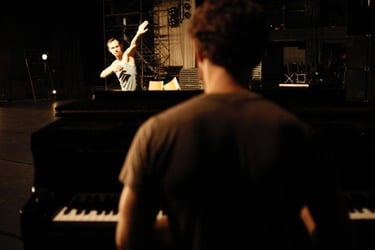
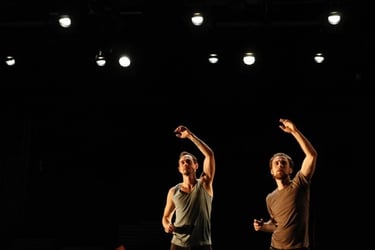
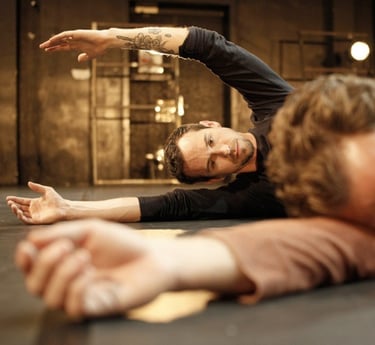
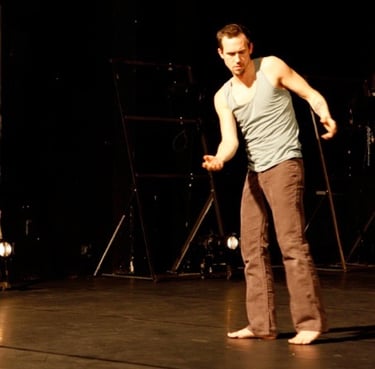

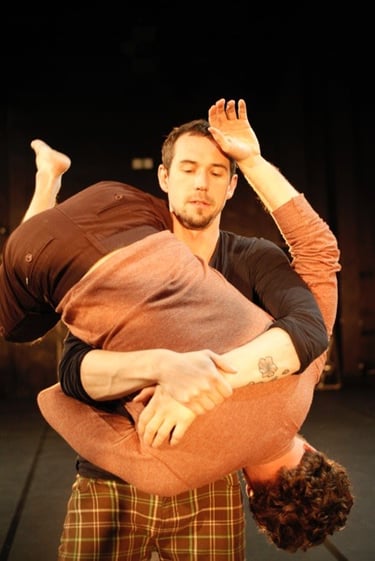


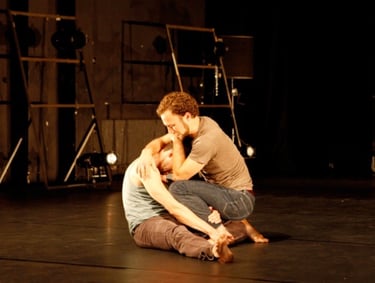
Loving is different than being in love. Loving is mutuality, attunement and modulation. Loving derives from prolonged contact and exposure of each body and person.
Based on the latest discoveries of neurosciences, Michael O’Connor and Brandon Gonzalez aim to cultivate love by creating an environment where their body systems can synchronize. As love is the foundation of life, it is urgently necessary to reveal that love can be learned and created as well. Advances in communication technology foster a false fantasy of togetherness by transmitting the impression of contact; phone calls, emails, sms. But no physical contact is actually exchanged. Not only as dancers, but also as humans we must continue to value the importance of touch. Limbic resonance is a concept that from our limbic brain, we are able to harmonize and become attuned to each other’s inner states through mutual exchange and internal adaptation, forming the empathic base for our social connections; in fact love is human kind’s strongest survival strategy. O’Connor and Gonzalez use the stage as a laboratory for creating what scholars, poets and songwriters have written about over centuries. Using song, atmosphere, emotion and motion, two men on stage offer the proposal “Can love be seen?” The dance, like love, is improvised, searching of human kind’s most desired experience.
“I hold this to be the highest task for a bond between two people: that each protects the solitude of the other–R.M. Rilke
“For one human being to love another human being: that is perhaps the most difficult task that has been given to us, the ultimate, the final problem and proof, the work for which all other work is merely preparation.” –R.M. Rilke
C. David Payr
